The Generative AI Revolution: A New Dawn for Creative Industries
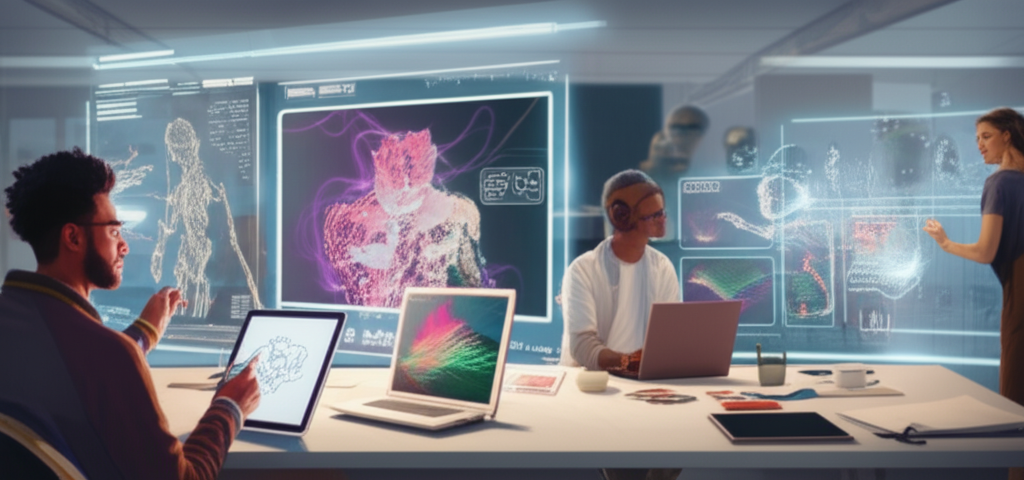
For centuries, creativity has been considered the exclusive domain of human ingenuity. Artists, writers, musicians, and designers have shaped our world with their unique visions. However, a profound shift is underway, driven by the rapid advancements in Artificial Intelligence, specifically Generative AI. This technology isn’t just assisting creative professionals; it’s becoming a co-creator, a tool capable of producing novel content that ranges from breathtaking visual art and compelling narratives to bespoke musical compositions and hyper-realistic digital environments. The implications are vast, promising to redefine not only how creative work is done but also the very definition of creativity itself. This blog post delves into the transformative power of Generative AI, exploring its burgeoning impact across various creative sectors, the challenges it presents, and the exciting future it heralds for human-AI collaboration.
The concept of machines generating original content once belonged firmly in the realm of science fiction. Today, it’s a vibrant reality. Generative AI models, powered by vast datasets and sophisticated algorithms, are learning to understand patterns, styles, and structures with unprecedented fidelity. They can then apply this learned knowledge to produce entirely new outputs that are often indistinguishable from human-created work. From text-to-image generators like Midjourney and DALL-E to advanced language models like ChatGPT, these tools are democratizing access to powerful creative capabilities, empowering individuals and large enterprises alike to explore previously unimaginable artistic horizons.
Understanding the Engine of Innovation: How Generative AI Works
At its core, Generative AI encompasses a variety of machine learning techniques designed to create new data instances that resemble the training data. Two primary architectures dominate the current landscape:
- Generative Adversarial Networks (GANs): These involve two neural networks, a ‘generator’ and a ‘discriminator’, locked in a perpetual game of cat and mouse. The generator creates new data (e.g., images), and the discriminator tries to determine if the data is real or fake. This adversarial process drives both networks to improve, resulting in increasingly realistic outputs.
- Transformer Models and Diffusion Models: Transformers, famously underpinning large language models (LLMs), excel at understanding context and generating coherent text. Diffusion models, on the other hand, have revolutionized image generation by learning to reverse a process of gradually adding noise to an image. By iteratively removing noise, they can generate highly detailed and novel images from scratch or from textual prompts.
These models are trained on colossal datasets – billions of images, trillions of words, vast libraries of music. This extensive exposure allows them to grasp intricate relationships, stylistic nuances, and the underlying logic of creative expression. The result is a system that doesn’t just copy but synthesizes, invents, and often surprises with its output.
Revolutionizing Art and Design: From Pixels to Masterpieces
Perhaps the most visually striking impact of Generative AI has been in the fields of art and graphic design. Tools like Midjourney, DALL-E 3, and Stable Diffusion have captured public imagination by allowing anyone to create stunning artwork with simple text prompts. This isn’t merely a parlor trick; it’s a fundamental shift:
- Democratization of Art Creation: Individuals without traditional artistic training can now manifest complex visual ideas, bridging the gap between concept and execution.
- Accelerated Prototyping and Ideation: Designers can rapidly generate countless variations of logos, product designs, or user interfaces, drastically cutting down ideation time. A study by Adobe found that designers using AI tools could complete tasks up to 50% faster.
- Personalized Content at Scale: Brands can generate unique visual content tailored to individual customer segments or fleeting trends, creating more engaging marketing campaigns.
- New Artistic Mediums: AI isn’t just a tool for existing art forms; it’s a medium in itself, giving rise to ‘prompt engineers’ and artists who collaborate with algorithms to forge entirely new aesthetic experiences.
From conceptual art to commercial design, Generative AI is empowering artists to push boundaries and freeing designers from repetitive tasks, allowing them to focus on higher-level strategic thinking and creative direction.
Transforming Content Creation and Marketing: The Word Whisperer
The written word has also experienced a seismic shift. Large Language Models (LLMs) like ChatGPT, Google’s Gemini, and Anthropic’s Claude are transforming how content is generated, optimized, and distributed:
- Automated Content Generation: From blog posts and articles to social media updates and email newsletters, LLMs can draft high-quality content at an unprecedented pace. This is particularly valuable for businesses requiring a constant stream of fresh material, with some estimates suggesting a 10x increase in content output for early adopters.
- SEO Optimization and Keyword Research: AI tools can analyze search trends, identify optimal keywords, and even suggest content structures that are more likely to rank well, ensuring greater visibility for digital content.
- Personalized Marketing Copy: Marketers can use AI to generate highly targeted ad copy, product descriptions, and sales emails that resonate deeply with specific audience segments, leading to improved conversion rates.
- Translation and Localization: AI-powered translation goes beyond simple word-for-word conversion, understanding context and cultural nuances to produce more accurate and natural-sounding localized content.
While human editors and strategists remain crucial for ensuring accuracy, brand voice, and ethical considerations, Generative AI is undeniably amplifying their capabilities and transforming content workflows.
Innovating Music and Sound Design: The Algorithmic Symphony
The auditory landscape is also ripe for AI-driven innovation. Generative AI is making strides in music composition, sound design, and even voice synthesis:
- AI-Composed Music: Platforms like AIVA or Amper Music can generate original scores in various genres for film, games, or marketing jingles, often tailored to specific emotional cues or durations. This offers a cost-effective and rapid solution for creators needing custom soundtracks.
- Dynamic Soundscapes: In video games and virtual reality, AI can create adaptive and evolving background music or ambient sounds that respond dynamically to player actions or environmental changes, enhancing immersion.
- Voice Synthesis and Cloning: Advanced AI can generate highly realistic human voices from text, or even clone existing voices, opening possibilities for audiobooks, podcasts, virtual assistants, and deepfake applications (which also raise ethical concerns).
- Musical Inspiration and Remixing: Musicians are using AI as a brainstorming partner, generating melodies, chord progressions, or drum patterns that can serve as starting points for their own compositions, adding novel textures to their work.
While purists may argue about the ‘soul’ of AI-generated music, its utility in commercial applications and its potential as a creative muse for human artists are undeniable.
The Film and Gaming Frontier: Crafting Immersive Worlds
The entertainment industry, particularly film and gaming, stands to gain immensely from Generative AI:
- Scriptwriting and Storyboarding: AI can assist screenwriters in generating plot ideas, character dialogues, or even entire script drafts, accelerating the pre-production phase. It can also quickly create visual storyboards from text descriptions.
- Character and Environment Design: Game developers can leverage AI to generate a vast array of unique non-player characters (NPCs), environmental assets, or even entire procedural landscapes, reducing development costs and time.
- Visual Effects (VFX) and Animation: Tools like RunwayML are enabling users to generate and manipulate video content with AI, creating complex visual effects, style transfers, or even synthesizing entirely new video sequences from text prompts or single images. This lowers the barrier to entry for high-quality video production.
- Game Level Generation: AI can design intricate and challenging game levels, often adapting them dynamically to player skill levels, ensuring a fresh experience with every playthrough.
The ability to rapidly prototype, iterate, and generate complex assets means that studios can focus more on narrative, gameplay mechanics, and creative direction, pushing the boundaries of immersive storytelling.
Challenges and Ethical Considerations: Navigating the New Frontier
Despite its immense potential, the rise of Generative AI is not without its complexities and ethical dilemmas:
- Job Displacement: A major concern is the potential for AI to automate tasks currently performed by human creatives, leading to job displacement in certain sectors. However, many experts believe AI will augment human roles rather than entirely replace them, creating new job categories like ‘AI whisperers’ or ‘prompt engineers’.
- Copyright and Ownership: Who owns the copyright of AI-generated content? What about content generated using models trained on copyrighted material without explicit permission? These legal questions are currently being debated in courts worldwide, creating a murky legal landscape for creators.
- Bias and Representation: Generative AI models learn from the data they are fed. If that data contains societal biases, the AI will perpetuate and even amplify them in its outputs, leading to issues of misrepresentation or harmful stereotypes in generated content.
- Authenticity and Attribution: As AI-generated content becomes indistinguishable from human work, questions of authenticity, artistic intent, and proper attribution become critical. How do we distinguish between human creativity and algorithmic output, and does it matter?
- Misinformation and Deepfakes: The ability to generate highly realistic images, videos, and audio poses significant risks for misinformation, propaganda, and the creation of malicious deepfakes, threatening public trust and individual privacy.
Addressing these challenges requires a collaborative effort between technologists, policymakers, ethicists, and the creative community to establish robust frameworks, guidelines, and responsible usage practices.
The Future: A Symbiotic Relationship Between Human and Machine
The narrative around Generative AI often oscillates between utopian promises and dystopian fears. The most likely future, however, lies in a symbiotic relationship – a powerful collaboration between human creativity and artificial intelligence. AI will serve as an extraordinary tool, an unparalleled assistant, and a boundless source of inspiration. It will:
- Amplify Human Creativity: By automating tedious tasks, AI frees up human creatives to focus on higher-order conceptualization, emotional depth, and truly novel ideas. It becomes a tireless apprentice, handling the grunt work while the human vision guides the project.
- Democratize Access: High-quality creative tools and capabilities will become accessible to a broader audience, fostering a new generation of diverse creators who might otherwise be excluded by cost or technical skill barriers.
- Spawn New Industries and Job Roles: As with every major technological revolution, AI will create entirely new industries, services, and job roles that we can barely imagine today, from AI ethicists to prompt engineers and AI content curators.
- Enable Hyper-Personalization: From individualized learning experiences to bespoke entertainment, AI will allow for creative content to be tailored to the preferences and needs of individual users on an unprecedented scale.
Ultimately, Generative AI is not here to replace human creativity but to augment, challenge, and expand it. It forces us to ask what it truly means to be creative, pushing the boundaries of artistic expression into uncharted territories.
Conclusion: Embracing the Algorithmic Muse
The ascent of Generative AI marks a pivotal moment in the history of creative industries. It’s a technology that is rapidly evolving from a niche curiosity to an indispensable tool, reshaping how art is made, stories are told, and experiences are designed. From visual arts and graphic design to content marketing, music composition, and immersive entertainment, its influence is profound and far-reaching. While the journey ahead is fraught with ethical considerations and societal challenges, the potential for innovation, personalization, and creative amplification is simply too vast to ignore. As we move forward, the most successful creators will likely be those who learn to effectively collaborate with their algorithmic muses, harnessing the power of Generative AI not as a replacement for human ingenuity, but as its most potent accelerator. The future of creativity is not just human or machine; it is the fascinating, ever-evolving partnership between the two.
Related Reading
https://www.adobe.com/newsroom/press/2023/10/adobe-executive-summary-generative-ai-the-next-frontier-of-digital-transformation.html
https://www.mckinsey.com/capabilities/quantumblack/our-insights/generative-ai-is-here-how-organizations-can-accelerate-value-creation
https://www.gartner.com/en/articles/what-is-generative-ai
Explore how Generative AI is revolutionizing creative industries, from art and design to content creation and music. Uncover its impact, challenges, and the future of human-AI collaboration.