The Dawn of a New Creative Era: Understanding Generative AI’s Ascent
In the vast and ever-evolving landscape of artificial intelligence, a new frontier has emerged, captivating the imagination of technologists and igniting a renaissance across industries: Generative AI. Unlike traditional AI systems designed primarily for analysis, prediction, or classification, Generative AI possesses the remarkable ability to create novel, original content—from intricate artworks and compelling prose to functional code and groundbreaking scientific discoveries. This paradigm shift is not merely an incremental improvement; it represents a fundamental leap, empowering machines to move beyond pattern recognition to genuine synthesis. The market for Generative AI is projected to reach an astounding $51.8 billion by 2028, underscoring its immense potential and the rapid pace of its adoption. As we stand at the cusp of this transformative era, understanding the core mechanisms, pervasive impacts, and inherent challenges of Generative AI becomes not just interesting, but imperative for anyone navigating the future of technology and business.
Generative AI’s roots can be traced back through decades of AI research, but its recent explosion in capability is largely attributable to advancements in deep learning, particularly the development of architectures like Generative Adversarial Networks (GANs) and Transformer models. GANs, introduced in 2014, pit two neural networks against each other—a generator that creates data and a discriminator that evaluates its authenticity—leading to increasingly realistic outputs. Transformer models, especially crucial for large language models (LLMs) like GPT-3 and its successors, revolutionized natural language processing by efficiently handling sequential data and capturing long-range dependencies, enabling machines to understand and generate human-like text with unprecedented fluency and coherence.
Reshaping Creative Industries: From Pixels to Prose
Perhaps the most visible and immediate impact of Generative AI has been its seismic influence on creative industries. Artists, designers, writers, and musicians are grappling with tools that can augment their creativity, automate mundane tasks, or even produce entire works from simple prompts. Platforms like Midjourney, DALL-E, and Stable Diffusion have democratized visual art creation, allowing anyone to generate stunning, photorealistic images or intricate illustrations in moments, challenging traditional notions of authorship and skill. Architects are using AI to generate innovative building designs, while fashion designers explore new patterns and material combinations.
- Art & Design: AI tools can generate endless variations of designs, suggest color palettes, or even create entirely new artistic styles, leading to significant acceleration in concept development.
- Writing & Content Creation: Large Language Models (LLMs) like ChatGPT are now capable of drafting articles, marketing copy, scripts, and even entire novels, significantly reducing the time and effort required for content production. Studies indicate that companies using AI for content creation report up to a 50% increase in output efficiency.
- Music & Sound Design: AI can compose original scores, generate sound effects, or even mimic specific artists’ styles, offering new avenues for musicians and producers.
While these tools promise unparalleled efficiency and creative expansion, they also spark vital discussions around intellectual property, the definition of human creativity, and the economic implications for creative professionals. The debate between AI as a co-creator versus a replacement continues to evolve.
Accelerating Innovation: Software Development and Scientific Discovery
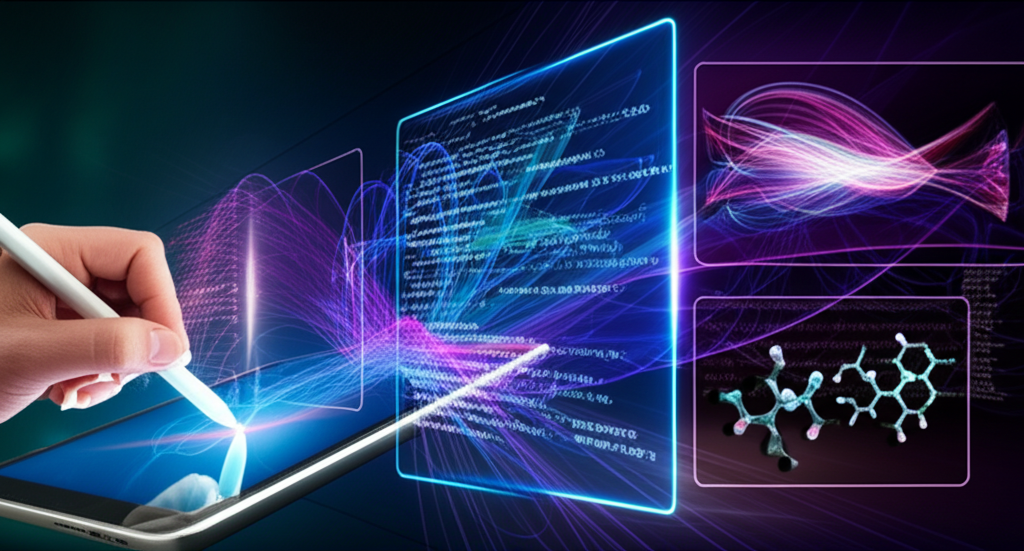
Beyond the creative sphere, Generative AI is making profound inroads into technical domains, fundamentally altering how software is built and scientific research is conducted. For software developers, AI-powered coding assistants are becoming indispensable tools, while in science, AI is dramatically accelerating discovery processes.
- Software Engineering: Tools like GitHub Copilot, powered by OpenAI’s Codex, can suggest code snippets, complete functions, and even debug complex issues in real-time. This not only boosts developer productivity by an estimated 30-40% but also lowers the barrier to entry for aspiring coders. AI can also generate test cases, automate repetitive coding tasks, and translate code between different programming languages, streamlining the entire development lifecycle.
- Drug Discovery & Healthcare: Generative AI is revolutionizing pharmaceutical research by designing novel molecules with specific therapeutic properties. AI models can predict drug efficacy, identify potential side effects, and optimize molecular structures, drastically cutting down the time and cost associated with drug development. In personalized medicine, AI can generate custom treatment plans based on a patient’s unique genomic data and medical history.
- Material Science: Researchers are using Generative AI to design new materials with desired characteristics, such as enhanced strength, conductivity, or heat resistance, opening doors for breakthroughs in areas like sustainable energy and advanced manufacturing.
The ability of AI to explore vast solution spaces and identify patterns imperceptible to humans positions it as an invaluable partner in scientific exploration, promising to unlock solutions to some of humanity’s most pressing challenges.
Transforming Business Operations and Customer Engagement
Businesses across every sector are leveraging Generative AI to optimize operations, enhance customer experiences, and unlock new revenue streams. The applications are broad, ranging from automating routine tasks to generating highly personalized marketing campaigns.
- Customer Service: AI-powered chatbots and virtual assistants can handle complex customer inquiries, generate personalized responses, and even proactively offer solutions, leading to higher customer satisfaction and reduced operational costs. Reports suggest up to a 70% improvement in first-contact resolution rates with advanced AI integration.
- Marketing & Sales: Generative AI can create highly targeted marketing content, personalize product recommendations, and even generate entire ad campaigns tailored to specific demographics. This precision marketing leads to significantly higher conversion rates and a more efficient allocation of marketing spend.
- Data Analysis & Business Intelligence: AI can synthesize vast datasets into actionable insights, generate reports, and create compelling data visualizations, empowering decision-makers with a deeper understanding of market trends and operational efficiencies.
- Product Design & Customization: Companies can use Generative AI to quickly prototype new product features or offer highly customizable products to consumers based on individual preferences, from shoe designs to home furnishings.
The strategic implementation of Generative AI offers businesses a competitive edge, fostering innovation, reducing costs, and enabling a level of personalization previously unimaginable.
Navigating the Ethical Maze and Societal Implications
While the opportunities presented by Generative AI are immense, its rapid advancement also brings forth a complex web of ethical dilemmas and societal challenges that demand careful consideration and proactive governance.
- Bias and Fairness: Generative models are trained on vast datasets, and if these datasets contain inherent biases (e.g., gender, racial, cultural), the AI will perpetuate and even amplify them in its outputs. This can lead to discriminatory results in hiring, lending, or even creative works.
- Misinformation and Deepfakes: The ability of AI to generate highly realistic text, images, and videos (deepfakes) poses a significant threat of creating and spreading misinformation, undermining trust in media and potentially influencing political discourse.
- Intellectual Property and Copyright: Who owns the rights to content generated by AI? If AI is trained on copyrighted material, does its output infringe on existing intellectual property? These questions are currently at the forefront of legal and artistic debate.
- Job Displacement: As AI becomes more capable, there are legitimate concerns about job displacement, particularly in roles involving repetitive or predictable tasks, as well as certain creative and analytical professions.
- Security Risks: Generative AI can be leveraged for malicious purposes, such as generating sophisticated phishing emails, creating believable fake online profiles, or even designing new malware variants.
Addressing these challenges requires a multi-faceted approach involving robust AI ethics frameworks, transparent development practices, public education, and potentially new legal and regulatory measures to ensure that Generative AI serves humanity responsibly and equitably.
The Horizon Ahead: What’s Next for Generative AI?
The journey of Generative AI is far from over; in many ways, it’s just beginning. The next few years promise even more sophisticated models, capable of multimodal generation (creating text, images, and audio simultaneously), enhanced reasoning abilities, and a deeper understanding of context. We can anticipate more specialized AI models tailored for niche applications, from scientific research to hyper-personalized education. The pursuit of Artificial General Intelligence (AGI), where AI can perform any intellectual task a human can, remains a distant but tantalizing goal, with Generative AI seen by many as a crucial stepping stone.
Ultimately, Generative AI is not just a tool; it’s a catalyst for a new era of human-machine collaboration. Its transformative power will redefine industries, challenge our perceptions of creativity and intelligence, and force us to confront profound ethical questions. The future will not be about whether AI generates content, but how we harness its power responsibly and creatively to build a more innovative, efficient, and ultimately, a better world.